February, 2005
To Whom It May Concern:
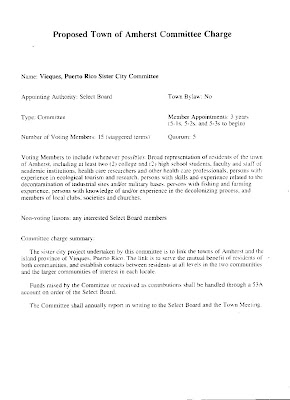
We are inviting you and/or your organization to participate in the Demilitarization, Environmental and Economic Justice Conference: The Case Study of Vieques, Puerto Rico. In celebration with International Women’s Week, we will present the first series at El Mercado (413 Main St., Holyoke) on March 9th from 3-5pm. This conference series will address the women’s role in the Vieques civil disobedience campaign and the struggle for peace. The delegation from Vieques, Puerto Rico includes Nilda Medina, a Founding Board Member of the Committee for the Rescue and Development of Vieques, Carmian Cespedes, representing Young Viequenses Leaders United, and Zaida Torres from the Vieques Women' s Alliance.
Conference participants will have the opportunity to hear personal testimonies from women of the three leading community organizations in the Vieques past and present struggle. This conference will also facilitate dialogue between the Puerto Rican delegation and participating colleges and communities in order to broaden knowledge about the obstacles that communities like Vieques in Latin America and in the U.S. are facing to reach greater control over economic and political decisions in the context of globalization. Furthermore, the conference will help facilitate a strong network for positive social change and promote solidarity with environmental, human rights and social causes in the region.
We are asking that your organization participate in the conference by sending a group of your members to the March 9th first conference series. Enclosed please find more information about the present struggle in Vieques and a form to fill out and send as soon as possible to Vladimir Morales at info@vozlatinamedia.com .
Sincerely,
Vladimir Morales, Asociaciòn Puertorriqueña en Amherst
Nadia Rivera-Nieves, Voz Latina Media Project
Robert Rabin, The Committee for the Rescue and Development of Vieques
+++++++++++++++++++++++++
Vieques: The Lost Paradise
Despite the cessation of bombing on May 2003, the Navy’s 60-year practices left a paradise lost for Viequenses. The Navy’s training contaminated the soil, water, air and marine sediments with its use of heavy metals (lead, mercury, cadmium and arsenic); napalm, uranium and explosives residues (TNT, RDX). Despite no other sources of pollution, residents’ cancer rate is about 40 percent higher than any other region of Puerto Rico.
In addition, the Congress did not return the Navy lands to their rightful owners - the people of Vieques. The transfer of the lands to the Fish and Wildlife Service of the Department of the Interior have significantly reduced the Navy’s responsibility to clean up the contaminated lands which threaten human health because these ‘conservation zones’ do not promote future social uses. Furthermore, according to the Spence Act, (congressional statutes regulating current Vieques/Navy lands issues), the Fish and Wildlife Service may allow the Navy necessary future military use of Vieques lands.
Vieques must also deal with 60 years of economic stagnation caused by the military presence. High unemployment rates characterize the economy of Vieques where two-thirds of the population live below the poverty level. This situation is aggravated by deficient infrastructure and health services needed to address the severe health problems related to the military contamination.
The lost paradise for Viequenses has become the promised paradise for wealthy, foreigners, mostly American, who want to “adopt” the island to construct mansions for retirement or vacation homes and profit from the new upscale tourism industry that has emerged since the Navy’s departure.
A wave of speculation by foreign real estate agents and investors have provoked uncontrolled price rises of land and property. Although government estimates indicate a shortage of about 600 housing units, the price increases have marginalized Viequenses from the possibility of buying homes or property. With the tourism industry also in hands of Americans, the few Viequense-owned businesses are now under pressure to survive against this new competition. Facing “an enemy without a face,” Viequenses are at a new phase of the struggle confronting the issues of corporate power and displacement of the native population that now characterize other Caribbean islands.